
Incomplete Discharge from Conveyor Plow Diverters? 3 Root Causes and Industrial-Grade Solutions
In bulk handling, inefficient conveyor plow diverters directly erode operational profits. When a conveyor plow diverter fails to clear cleanly, residual fines on the return belt trigger carryback and severe misalignment, leading to material buildup and accelerated wear around the tail bend pulley. If your team constantly clears spillage under discharge points, your system likely suffers from these three common faults.
A.Quick Diagnosis Table
Before diving into specific details, you can use the table below to quickly match on-site symptoms with their most likely root causes:
| Observed Symptoms | Possible Root Causes | Immediate Actions Required |
| Material escaping from beneath the center of the plow blade | Weakened spring tension or insufficient actuator pressure | Adjust the tensioning mechanism; check pneumatic/hydraulic cylinder pressure. |
| Uneven streaks of material residue on the belt | Localized plow wear, blade chipping, or impact from mechanical belt fasteners | Replace the worn blade; upgrade to a cushioned polyurethane plow blade. |
| Plow blade lifting or vibrating violently during operation | Poor alignment or insufficient structural rigidity of the belt-flattening idlers | Inspect the lifting mechanism and the overall structural rigidity of the flat idlers. |
B.3 Root Causes of Incomplete Discharge from Conveyor Plow Diverters
1.Insufficient or Uneven Plow Blade Pressure
· Conveyor plow diverters rely on precise, continuous downward pressure to maintain optimal contact with the moving conveyor belt. Over time, mechanical springs suffer from fatigue, or pneumatic/hydraulic actuators experience minor pressure drops.
· If the pressure falls too low, the high-speed material stream will lift the plow blade, allowing fines and high-moisture materials to escape from beneath the blade skirting.
2. Improper Scraper Material Selection and Wear Deformation
· Using low-end rubber lagging or blades to cut initial costs is a primary cause of inefficient material clearing.
· Standard rubber hardens and loses elasticity in low-temperature environments, and it is highly prone to uneven wear when handling highly abrasive materials like coal or iron ore. Once the scraper edge loses its straightness, a perfect seal with the belt becomes impossible to achieve.
3. Failure of the Belt-Flattening System (Transition Idlers)
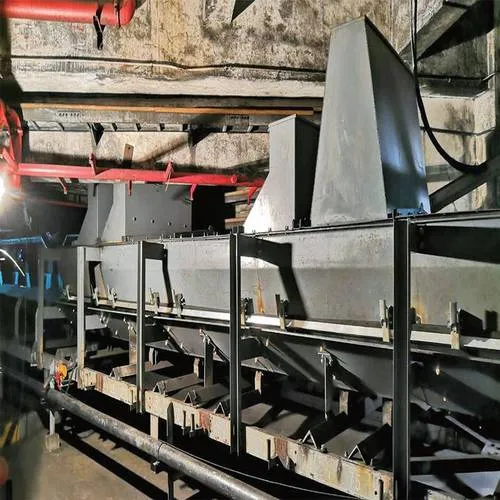
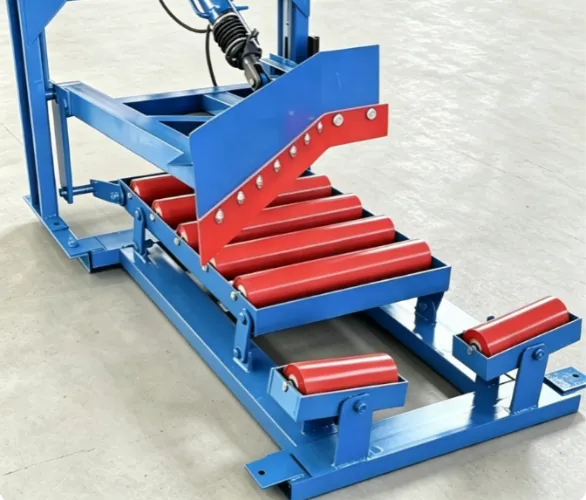
· Conveyor belts naturally maintain a troughed profile when running over troughed idler sets. For a conveyor plow diverter to achieve clean discharge, the belt must be transitioned to a completely flat profile at the discharge point.
· If the flat idler sets or the flattening bed at the discharge point are misaligned or worn, the belt will sag slightly under the heavy load of the material, creating an irremediable "V-shaped" gap between the belt and the plow blade.
C.How to Troubleshoot and Resolve the Issue: Systematic Maintenance Steps
To restore your conveyor plow diverter to peak efficiency and achieve clean discharge, follow this structured procedure:
Step 1: Structural Inspection — Inspect and Flatten the Belt Profile
Ensure the mechanical lifting bed or flattening idlers are fully engaged. The conveyor belt must remain perfectly flat across the entire discharge zone to eliminate any geometric gaps. If any sagging, misaligned, or seized idlers are identified, replace or realign them immediately.
Step 2: Material Optimization — Upgrade to High-Performance Polyurethane (PU) Blades
· Replace traditional rubber scrapers with segmented polyurethane (PU) blades. It is recommended to select high-performance polyurethane with a hardness between Shore 85A and 90A.
· This specific hardness ensures exceptional wear resistance while maintaining sufficient flexibility to prevent damage to the conveyor belt surface. In heavy-duty mining environments, its service life is typically 3 to 5 times that of traditional rubber.
Step 3: Pressure Fine-Tuning — Calibrate the Tensioning and Safety Cushioning System
Adjust the spring tension or pneumatic actuator pressure to ensure a uniform downward force across the belt.
💡Technical Key Point:
· When calibrating pressure, verify the conveyor belt splice type simultaneously. If mechanical belt fasteners (non-vulcanized splices) are used on-site, it is highly recommended to integrate an automatic-bypass or resilient cushioning module into the tensioning mechanism.
· This prevents the plow blade from hard-impacting the mechanical fasteners, which can cause blade chipping or catastrophic belt tearing.
D.Eradicating Discharge Deflection Through Structural Design
1.When handling high capacities (exceeding 800 t/h) or large lump materials on conveyor lines, standard single-sided conveyor plow diverters are highly prone to torsional deflection due to severe single-sided material impact, leading to asymmetrical wear.
2.In such scenarios, upgrading to a heavy-duty, bidirectional V-plow design is the optimal choice. It evenly splits the material flow to both sides of the conveyor, balancing lateral impact forces to significantly reduce structural deformation of the plow mechanism. This ensures a clean, "zero-residual" discharge even under heavy-duty operating conditions.
☏Need a Customized Technical Solution?
Whether you are currently designing a new material diversion project or retrofitting an existing, problematic discharge point, our engineering team is here to help. We can provide complete, tailored technical drawings and solutions based on your specific belt width, material density, and operating speed requirements.
Related News
- How to Stop Material Spillage at Conveyor Discharge Chutes: 5 Proven Fixes
- Why the Wire Ropes of Horizontal Gravity Take-ups HGTU Break Frequently? Root Cause Analysis and Practical Checklist
- Why do conveyor idler brackets fracture easily in heavy-duty mining areas?
- Guide to Daily Inspection and Quick Replacement of High-Elastic Buffer Bars in Guide Chute Under Harsh Copper Mine Conditions
- What is carryback? How to eliminate it?
- How to Stop Belt Edge Wear Against Conveyor Frame
Leave me a message