
Why the Wire Ropes of Horizontal Gravity Take-ups HGTU Break Frequently? Root Cause Analysis and Practical Checklist
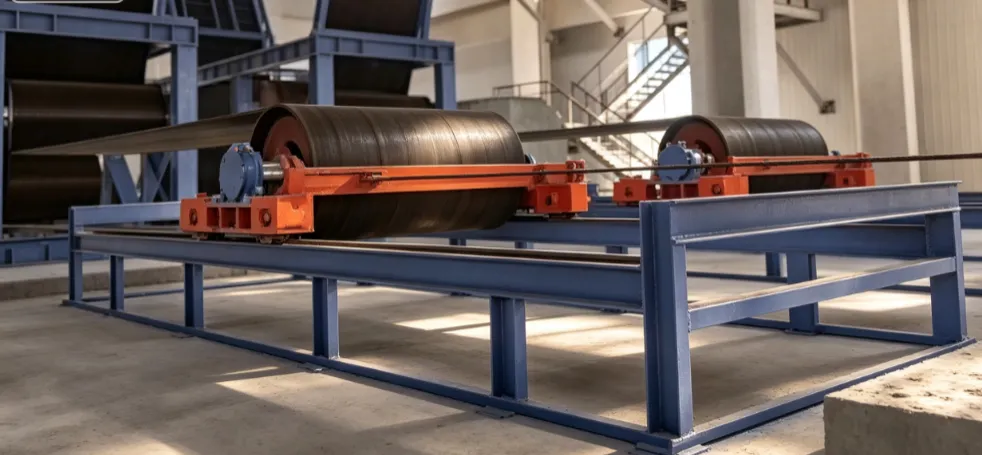
In heavy-duty bulk material handling systems, a sudden wire rope failure on a Horizontal Gravity Take-up (HGTU) is extremely dangerous. The unexpected drop of a counterweight weighing several tons not only results in expensive unplanned downtime but also poses catastrophic safety risks.Why do these wire ropes break so frequently? Below are the 7 core causes of failure and a practical on-site troubleshooting checklist.
A.7 Core Causes of Wire Rope Failure on Horizontal Gravity Take-ups (HGTU)
1.Bending Fatigue Failure
The wire rope of the Horizontal Gravity Take-up (HGTU) is subjected to complex alternating stresses as it repeatedly passes over the sheaves during operation.
Note: Internal core wires usually wear out faster than outer strands. This degradation happens deep within the structure, making it highly concealed during basic surface inspections.
2.Sub-optimal Sheave-to-Rope Diameter Ratio (D/d Ratio)
Global engineering standards (such as CEMA) specify that the ratio of the sheave pitch diameter to the nominal rope diameter (D/d) must be at least 20:1 to 40:1. Undersized sheaves force the wire rope into an excessively tight radius, accelerating bending fatigue at an exponential rate.
3.Insufficient Safety Factor and Tension Anomalies
The tensile safety factor for take-up wire ropes on bulk material handling conveyors should never be lower than 5.5. Conversely, insufficient tension causes belt slack during start-up or shut-down, generating massive dynamic shock loads that snap the rope.
4.Mechanical Wear and Internal Abrasion
Continuous hard friction between the wire rope of the Horizontal Gravity Take-up (HGTU) and worn sheave grooves or misaligned deflector pulleys steadily reduces the metallic cross-sectional area and compromises its overall load-bearing capacity.
5.Corrosion in Harsh Environments
In humid, open-pit, or chemically aggressive mining environments, moisture and corrosive elements cause pitting corrosion on the metal surface. This not only reduces the load-bearing area but also creates severe stress concentration points that fast-track fatigue cracking.
6.Inadequate Lubrication
Without regular application of high-penetration wire rope lubricants, internal steel wires experience severe dry friction under load, creating intense localized heat, micro-welding, and rapid rope degradation.
7.Severe and Frequent Shock Loads
Abrupt conveyor start-ups, emergency braking sequences, or sudden material jamming in chutes generate instantaneous peak tensions. These transient shock loads can easily multiply beyond the actual breaking strength of the Horizontal Gravity Take-up (HGTU) wire rope.
B.Maintenance Engineer's On-site Checklist
| Inspection Item | Industrial Standard & Technical Specification | Significance & Purpose |
| Comprehensive Periodic Inspection | Combined Visual and Tactile Inspection | Focus on broken wires, pitting corrosion, and localized deformation to prevent sudden rope breakage |
| Outer Diameter Loss Measurement | 10%Actual wear diameter loss < 10% | According to ISO 4309, the rope must be replaced immediately if the diameter reduction is ≥ 10% |
| Sheave Diameter Verification | D/d ratio ≥ 20:1 (30:1 recommended) | Increasing the sheave diameter can significantly extend the wire rope service life |
| Safety Factor Validation | Safety factor ≥ 5.5 | Ensures the verified strength of the wire rope satisfies normal operation as well as start-up and shut-down conditions |
| Implementation of Standard Lubrication | High-penetration specialized wire rope grease | Minimizes internal friction and seals out moisture. Lubrication is a core maintenance task |
| Inspection of Sheaves and Guide Chute | Inspect for groove wear and misalignment | Groove deformation (such as wearing into a V-shape) will pinch the wire rope, leading to accelerated eccentric wear |
| Take-up Carriage Monitoring | Ensure the travel track is completely free of any mechanical jamming | Mechanical jamming will directly force the wire rope to bear several times its design load |
| Establishment of Operational Logs | Record installation dates, broken wire count progression, and replacement intervals | Empowers the technical team to identify cyclic patterns and implement predictive maintenance |
C. Conclusion & Expert Recommendations
1. Frequent wire rope failure in Horizontal Gravity Take-up (HGTU) systems is rarely a random accident—it is typically the combined result of improper initial selection (such as undersized sheaves and an insufficient safety factor) and a lack of proper routine maintenance.
2. As a professional manufacturer deeply specializing in high-capacity, heavy-duty mining conveyors and core components, Baoding Ruileier Conveyor Equipment Manufacturing Co., Ltd. is dedicated to optimizing take-up systems for global mining clients. We provide:
· Take-up system stress verification and fatigue evaluation
· High-compatibility selection and matching of
wire ropes and sheave components
·Technical Consultation on the Full Lifecycle of Tensioning
Device Assembly
If your conveyor is experiencing wire rope breakage issues, please contact the Rui Le'er International Technical Service Team for a complimentary technical evaluation and customized solutions.
Related News
- How to Stop Material Spillage at Conveyor Discharge Chutes: 5 Proven Fixes
- Incomplete Discharge from Conveyor Plow Diverters? 3 Root Causes and Industrial-Grade Solutions
- Why do conveyor idler brackets fracture easily in heavy-duty mining areas?
- Guide to Daily Inspection and Quick Replacement of High-Elastic Buffer Bars in Guide Chute Under Harsh Copper Mine Conditions
- What is carryback? How to eliminate it?
- How to Stop Belt Edge Wear Against Conveyor Frame
Leave me a message