
What are the safety regulations for mining belt conveyors?
Mining belt conveyors can continuously transport wet and dry powdery, lumpy, and even packaged goods. Even under the complex conditions of heavy loads and high wear in mines, they can operate stably thanks to their high-strength structural design. However, this also makes the safety management of mining conveyors a top priority for mine safety production. We have systematically reviewed the full-process safety regulations for mining belt conveyors, providing clear guidance for enterprises to strengthen their transportation safety defenses.
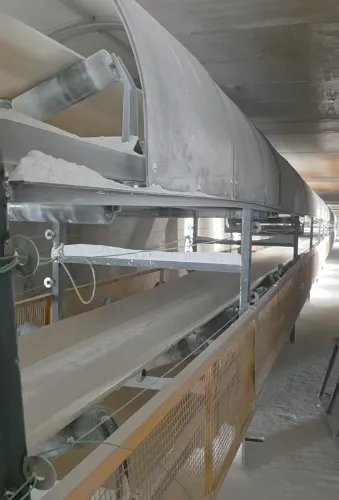
I.Multi-machine collaboration: Centralized control solidifies the foundation of system safety
1.In large-scale conveyor systems in mines, the joint operation of multiple belt conveyors is common. Such systems require a central control console to centrally control all equipment.
2.The central control console is the device for accurate control and needs a comprehensive audible and visual signal system to clearly report the on/off status of each piece of equipment, allowing dispatchers to monitor the entire line's operation in real time and avoid operational errors caused by information asymmetry.
II.Protective Devices: Interlocking Facilities Must Not Be Altered or Removed at Will
Interlocking devices are essential in mining belt conveyor equipment. They enable the linkage between equipment actions. The matching interlocking devices are core safety components, preventing the entire line from being paralyzed or causing safety accidents due to the failure of a single piece of equipment. This device must not be altered or removed at will.
III.Start-Stop Control: Ensuring Stable Material Transfer
1.Mining-duty belt conveyor lines shall be started sequentially against the material flow direction and shut down in a delayed sequential manner along the material flow direction.
2.Provided that comprehensive anti-spillage safeguards have been fully implemented in advance, simultaneous start-up or simultaneous braking may also be adopted based on actual site operating conditions.
3.Regardless of the start-stop mode employed, the control system must deliver high operational reliability and precise actuation accuracy. It shall enable rapid response to emergency scenarios, facilitating a one-touch emergency power cut-off for the entire line to achieve the safe shutdown of all connected equipment.
IV.Emergency Response: Fire Situation Requires Differentiated and Scientific Handling
When a fire occurs on a mining belt conveyor during operation, operators must stop the machine immediately before carrying out firefighting operations to prevent the fire from spreading due to equipment operation.
However, if the fire is on the idler rollers, firefighting operations should be prioritized, and the machine should only be stopped after the fire is under control to prevent the fire from spreading to the entire conveyor belt due to machine shutdown.
V.Hot work operations: Special conditions require comprehensive preventative measures
After the mining belt conveyor is installed, welding or other flammable tools are not permitted. If the equipment must be used due to special circumstances such as maintenance or modification, necessary precautions must be taken. After the operation is completed, a comprehensive inspection of the site must be carried out to confirm that there are no remaining sources of ignition before leaving.
VI.Conveying Matching: Precisely Matching Conveying Capacity to Avoid Overload and Overflow
In conventional conveying scenarios, the conveying capacity of the downstream receiving equipment must be greater than or equal to the conveying capacity of the upstream feeding equipment to ensure smooth material transfer and prevent accumulation and blockage. However, in reverse conveying under loaded conditions, to prevent instantaneous material accumulation that could cause overflow and equipment overload, the conveying capacity at the receiving end must be greater than that at the feeding end.
VII.Personnel Operation: Certified Operators, Standardized Work Practices
Operators of mining belt conveyors must be certified and undergo professional training and assessment to master the equipment's operating procedures and emergency response methods.
VIII.Standardized implementation
Only by strictly implementing these safety regulations, equipping the facilities with comprehensive safety protection devices, and strengthening personnel safety training can enterprises truly leverage the advantages of efficient transportation using mining belt conveyors, while simultaneously strengthening the safety defenses of mine transportation and ensuring safe production in the mine.
Related News
- How to Inspect and Replace Drive Pulley Lagging?
- What are the root causes of high energy consumption in conveyor drive systems?
- How to effectively prevent conveyor belt slippage?
- Selection guide for primary cleaner
- What are the precautions for the maintenance and repair of conveyor belts?
- What should be noted in the selection of conveyor pulleys?
Leave me a message